Architecture isn’t a Metaphor.
categories:
- “life” tags:
- “computers”
- “social-networking”
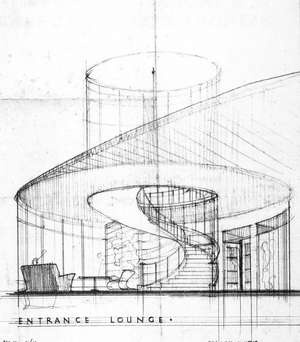
My employers have just rolled out this large new product for sharing stuff on-line. The biggest useability problem is that they employ architectural metaphors without regard. There are “rooms” and “places” and... I could go on, but I just want to waste a moment of out time on why architectural metaphors for online things doesn’t work.
First problem is, there are no online things. It’s all data displayed, so thinking of knowledge-representation as atomic constructs is a risky beginning. While it works, you must either rigidly codify according to your metaphor, or not be surprised when users encounter your usage with confusion. In the architecture metaphor, “places” might be geographic locations that contain many “rooms.” (Though a “building” or even just an “address” should be in between there somewhere, to anchor a collected subset of “rooms” to that “place.”)
So that first problem was, if you choose a metaphor, you’ve got to go all-in, all the way, or not at all. Half-measures leave people fully lost. The second problem comes more specifically with architecture. I’m pretty ok at reading blueprints, and knowing my way around from them. A simple plan, I can form a mental image, and get around and know the space viscerally before seeing it. A complex plan? I’ll need the prints in my hand as I walk to navigate a complex path, but that inner feel for how big or how far, that’s there. It’s of course nothing like being there for real, but still.
And that’s the hint that architecture is not the best online metaphor. It’s because in the real world, we know architecture by process, by the path, not necessarily the destination. It’s been 15 years since I’ve been in the Museum of Science and Industry, but I’ll bet I can find even obscure locations pretty easily. Renovations are constant, but I’ll bet my path-memory still works.
So that’s the second problem: architecture as metaphor is not location-knowledge, it’s path-knowledge. (I’ve got an earlier posting on how we recall not by position or placement, but by process, See “There’s No Such Place as ‘Away’”) So, if you need to use a metaphor, especially to give people a starting place, you need to rigidly stick to that metaphor’s heirarchy of ideas in order to get that starting place value. If you break from it, expect that the confusion you’ll see will be all over the map. Trying to find a pattern to that confusion may be impossible, because the break is so low-level that people’s own experience will seep through all over the place and come at you from multiple angles.