Pittsburgh Bridge Collapse
categories:
- “life”
- “ramblings”
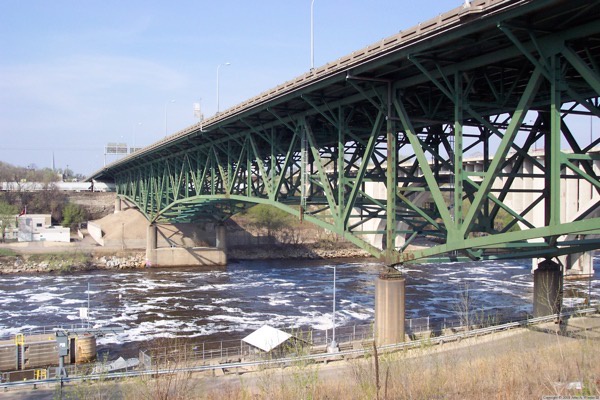
I-35W over the Mississippi at Minneapolis; the version, precollapse.
Last night, the Forbes Avenue bridge over Frick Park collapsed. I’m not going to cite anymore facts than that because, as On the Media podcast teaches us, everything we know now will be wrong in a week. And everything we know a week from now will be contradicted in a month…and so on.
I want to talk about the after-effects for just one person from another bridge collapse. And the broader impact of choosing not to care to save money. In August ’07, the I-35w bridge over the Mississippi River (Minneapolis) collapsed. There was a design feature that aged poorly, and a unusual static-load of parked equipment from the day’s work on resurfacing. I even commented on this to my girlfriend at the time we drove over it. We totally missed it, we were safely at home when her sister called asking if she was ok. We tuned in to news and it was a very distant thing, at the time. No big impact, didn’t even really hit me how big the mess was. About the only thing I noticed right away was having to find new routes to St. Paul.
Slow-forward through years that took me to driving UNDER the construction a few hundred times, as well as finally crossing the new bridge 2 days after opening. Interesting side note: that route under the bridge took me under several other bridges: 46th, Lake, the old RR bridge, Franklin, I-94, and 10th ave. I watched the entire resurfacing of Franklin and 10th from below.
Present day, and my heart aches for the folks in Pittsburgh who are going to wake up someday soon and realize that bridges aren’t permanent. Given our neoliberal austerity, they’re not even reliable anymore. And this is pretty traumatic over time.
There are 2 models of durability. I’m paraphrasing either Dr. Jonathon Miller (The Body in Question) or James Burke (Connections) here when explaining. There’s the “statue” and the “fountain.”
You can make something last by picking extremely durable materials and performing a LOT of work on them. “Work” here means the chopping, chiseling, grinding, etc but it also includes the making of axes, chisels, grinders, etc. And work in the physics sense, force over distance consuming energy to do it. The result is a solid, usually heavy thing that you plop down and let birds poop on it. It’s there for as long as it remains, though choosing the wrong materials not anticipating future environmental changes could mean acid rain washes the hero’s face off a lot sooner than expected.
The other option is ephemeral, you design a system that continually remakes itself. This is called “the fountain” confusingly because most of us think of fountains as all the structural bits, cherubs peeing, dolphins dolphinning, Poseidon or Aquaman or whoever lounging. All heavily in the “statue” model of durability. No, for this model, think of the founaining itself. The prancing fluids. Constantly renewed, turn off the water and they’re instantly gone. In this model of durability, we spend much less energy up-front making the thing in exchange for a low energy bill that goes on for a veerrry long time. Interesting side note: that looong, low consumption of energy can readily total far more than used in the statue model.
Buildings, roads, and bridges use the statue model. Humans, mayflies, and laser beams use the fountain model.
But here’s the rub: in the original quote, the author used “permanence” instead of durability. I’ve dropped this because over any unknown timescale, nothing is permanent. (Mention the oxymoron at your peril.) Entropy never sleeps, everything needs maintenance. True, it may not need much maintenance, going decades between cleanings, repaintings, or repairs. But never skimping on inspection, because schedules assume climate and environmental wear and that bridge planner had no idea what climate change would become, or even how 40-series radials under 1.5 ton cars behave differently from 70-series bias-plies under +2 ton cars.
And so we return to my previous political-economic dig at the reactionaries. By continually cutting budgets as a straw-man for shrinking government, inspectors became charged not with inspecting but with guessing how long they could postpone inspections before something bad would happen. Linear progression of corrosion, advances in cracks, perhaps even deformation of gussets (I-35w failure) were all accounted for on paper, then spreadsheets, then computer models, and ever-longer intervals to ever-weaker inspections were made. Until the unintended consequence of all those consequences adds up non-linearly. Then something goes boom.
I worked for 7 years in sight of 2 bridges upstream of the I-35w crossing, and watched them undergo the harrowing job of inspection. I have to think Minnesota’s now at about peak inspection, having gone hog-wild-but-probably-ineffective for a few years after I-35w collapsed. We’re now in the golden age where we’re still seriously committed, using novel science to its fullest, and generally avoiding the idiocy of budget cutters. Pennsylvania has entered the panic ass-covering stage. If you drive one of those amazing boom trucks, you’re going to make 5 years of overtime while electeds insist on their butts being thoroughly insulated by paper and signatures. You’ll settle down to MN’s current level in a while, then cruise for a period while voting citizens still remember where they were when Forbes Ave crashed.
But MN will soon, and PA less than 15 years later, re-enter the phase of “Harrumph, why are we spending all this money inspecting bridges?” Note I said “inspecting.” No one would be foolish enough to question maintenance, noooo. But inspections? “Surely science has advanced since then?” Begins the slow trickle of eroding austerity-trons and within a decade, we’ll be back to waiting for that non-linear bit of unanticipated consequences to announce itself with another boom.
What we need, until we can show austerity for the naked conversion of public funds to private wealth that it really is, is a grayer definition of “durability” or even “permanence.” We need to understand that “build it and forget it” doesn’t even happen to space probes. “Caring for” shouldn’t be seen as a cost to be cut but as an investment that pays off.
Let’s point out to the reactionatries that using budget-cutting as a stand-in for the really hard work of actually shrinking government is a fool’s game. Like the debt ceiling bullshit, it’s a paucity of thought being fobbed off on the proletariat. Sloganeering. Attach a pittance of returned taxes, and the lie of trickle-down, and it’s such a lazy sell that it’ll be hard to replace.
But when bridges start falling down, it’s time to do the hard work of recovering trust in the floor under your feet and replacing a route over an obstacle.