Energy or Information Density
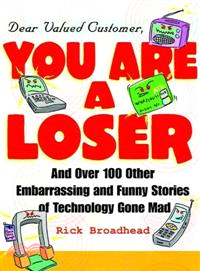
Wired has a review of the book “Dear Valued Customer, You are a Loser” by Rick Broadhead <http://www.wired.com/news/culture/0,1284,64734,00.html> And I know I must check this book out. But the mere theme of the review—that humans are losing “the fight” with technology—seems awfully Wimbeldon-esque.
Not everything is a competition. It just seems to me to be keeping situational awareness of the energy and information density of our toys. Remember the “dangers” of rechargeable batteries? I think it was at Woodstock 2 (gack, but for another time) that the big producer-type of a local radio station stocked up on spare batteries to go do interviews. And the chain on his wallet was a tad conductive... I think he might have a chain-scar on his butt, though I may be unclear on the story.
And info-density is like paint: you can cover more floor (stretch the boundaries of the performance-envelope) but the coat will be thinner. So we have cell phones that have wildly variable alerting systems, sometimes grouped in the UI for easier selection, but have not one clue how to deal with the alerting either per-incident or per-circumstance. (Why can't I silence all incoming notifications unless they're from so-and-so? Why can't the ambient-volume determine the type of notification used, based on other priority-rules?) We have enough programming to reach the new feature-sets (variable alerts) but not enough to employ those new features with ease. Now I should speak in my own offense here, I am notoriously bad at thinking a cool new feature is nowhere to be found, while the guy sitting next to me has had it for a year. So if you're Moto'kia-Ericsony-Glorkdiible-foomwanger-and-Vought cellphone has had all and more than what I described, I'll not be surprised. It doesn't change my basic point. For example: look at the control room of a nuclear plant. Or an airplane. (Let's pick Airbus for their commitment to “envelope protection”) How does that display come even close to informing the naked ape operating it that choice A is correct and choice B is disaster? Let's take the Airbus, shall we? There was a notorious (and horrific video to watch) crash wherein the pilot was essentially fighting the autopilot. The plane dragged along and barely tree-top height, nose pointed to the sky, engines turning, and just finally crashed when (treetops-3 feet) meant so much drag as to pull it down. In other words, over a desert, the plane probably would've flown on for hours in that ridiculous attitude/state until someone noticed the position of a rotary switch on the glareshield. My point? There are a lot factors including human-factors in design and production of something, and currently the cost of producing those human-factors related features are too expensive to apply in sufficient depth to eliminate these racial errors. Should the Space Shuttle be flyable by an 8 year old? Ok so this is not entirely possible, I am thinking of the revised version of the Hitchhikers Guide to the Galaxy in the last book (#5 of the trilogy). It proceeded to ask the user certain questions about the frequency of light the user was sensitive to, which direction of time the user perceived as forward, how many spacial dimensions the user lived in, and so on. Now that's pretty extreme on the usability scale, but great if you can. No, I expect that the Space Shuttle will always take some training. It's just that I expect that a lot of the training CURRENTLY needed will someday be judged as concessions toward the limits of the user-interface. Hopefully we can produce as much improvement in the overall info-density of current products as we spend on pushing the leading edge out over new territory. (There was a slashdot article on this, talking about fixing the UI as a priority in programming, not just adding capabilities.) How unglamorous, the objective is to wrap the entire sphere of possibilities like Christo, not to spend the time making repairs to the parts already covered. Why doesn't your desk-phone have the same features as your cellphone? Try dialing a 10 digit number on your kitchen phone and see what happens... For the vast majority, the network will reject the call as too many or too few digits. {{UPDATE 2007: Try dialing a US number from overseas: put + in front of the 1, a PRESTO! Works like magic.}} Why? It works on my cell phone 100% of the time. Is it merely dumb instruments? Do IP telephones have these features? How much smarts do we have to imbue our telephones with before we can make them universally useable? Oh I'm out of caffeinated fuzzy-water, I need to go find Charlie for a refill. Sorry to putter off in mid rant (or mid-whine) but one must keep RL in proper perspective to asynchronous-text-messaging. Cheers, and join me at Charlie's, I'll buy.